How Blockchain Ensures Transparency & Trust
In today’s digital economy, businesses and consumers expect greater transparency, stronger security, and more trustworthy systems. Whether it’s online payments, healthcare records, supply chain management, or financial transactions, traditional centralized systems often struggle with issues like fraud, data manipulation, limited visibility, and lack of accountability.
This is where blockchain technology is transforming industries across the United States.
Blockchain has become one of the most important innovations driving the future of digital trust. By creating decentralized, immutable, and transparent record-keeping systems, blockchain helps organizations build confidence, improve accountability, and reduce dependence on centralized intermediaries.
As businesses increasingly adopt Web3 technologies, organizations focused on innovation and digital transformation, such as Melmark, recognize the growing importance of secure and transparent digital ecosystems.
What is Blockchain Technology?
Blockchain is a decentralized digital ledger that records transactions across a distributed network of computers.
Unlike traditional databases controlled by a single authority, blockchain distributes records across multiple nodes that collectively verify and maintain the system.
Each transaction added to the blockchain is:
- Verified by network participants
- Time-stamped
- Cryptographically secured
- Linked to previous transactions
- Stored permanently on the ledger
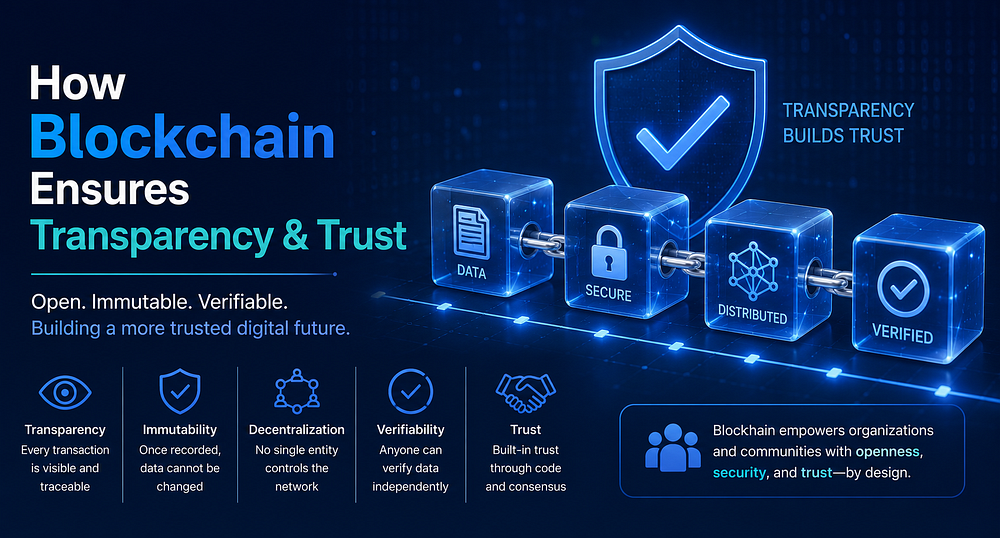
Researchers explain that blockchain’s core features — immutability, decentralization, and consensus verification — make it especially valuable for improving transparency, traceability, and trust in digital systems.
Why Transparency Matters in Modern Business
Transparency is critical in industries where trust and accountability are essential.
Traditional systems often create problems such as:
- Data silos
- Limited visibility
- Fraud risks
- Manual verification delays
- Centralized control
- Difficult auditing processes
Blockchain addresses many of these issues by creating a shared and verifiable source of truth.
Industry experts increasingly describe blockchain as a “shared truth” infrastructure that enables trusted collaboration across decentralized ecosystems.
How Blockchain Creates Transparency
1. Distributed Public Ledger
One of blockchain’s most important features is the distributed ledger.
Instead of storing records in one centralized database, blockchain distributes identical copies of the ledger across multiple network participants.
This creates shared visibility and accountability.
On many public blockchains, anyone can view transaction history through blockchain explorers, making the system highly transparent.
Because all participants can access the same verified data, there is less opportunity for hidden manipulation or unauthorized changes.
2. Immutable Transaction Records
Blockchain transactions are designed to be immutable, meaning they cannot easily be altered or deleted once recorded.
Each block contains a cryptographic hash linked to the previous block, creating a secure chain of records.
Any attempt to modify past data would disrupt the entire chain and become immediately detectable.
This immutability improves:
- Auditability
- Accountability
- Fraud prevention
- Historical record integrity
Industries such as finance, healthcare, and supply chain management increasingly rely on immutable blockchain records to strengthen operational trust.
3. Decentralized Verification
Traditional systems often rely on centralized authorities to validate transactions.
Blockchain uses decentralized consensus mechanisms instead.
Transactions are verified collectively by network participants before being permanently added to the ledger.
This reduces dependence on single institutions and minimizes the risks associated with centralized manipulation or corruption.
Decentralized verification creates stronger trust because no single entity controls the system entirely.
4. Real-Time Traceability
Blockchain improves transparency through end-to-end traceability.
Every transaction is time-stamped and permanently recorded, creating a transparent audit trail.
This is especially valuable in industries such as:
- Supply chain management
- Healthcare
- Food safety
- Logistics
- Real estate
- Financial services
Researchers note that blockchain significantly improves traceability and provenance tracking across modern supply chains.
Businesses can track products, transactions, and records in real time while improving accountability throughout the entire ecosystem.
5. Open-Source Infrastructure
Many blockchain protocols operate using open-source software.
This allows developers, security researchers, and organizations to inspect and verify the underlying code independently.
Open-source transparency strengthens trust because systems can be audited publicly rather than relying entirely on proprietary infrastructure.
How Blockchain Builds Trust
Transparency alone is not enough — blockchain also helps create trust.
Trust Through Verification
Blockchain allows users to verify information directly instead of depending solely on third parties.
Transactions become mathematically verifiable through cryptography and consensus systems.
This creates “trustless trust,” where users rely on transparent systems rather than centralized institutions.
Trust Through Accountability
Because blockchain records are permanent and visible, organizations become more accountable for their actions.
Fraudulent modifications or hidden changes become far more difficult.
Trust Through Security
Blockchain systems use advanced cryptographic security to protect transaction integrity.
Distributed infrastructure also reduces single points of failure.
Industry experts continue describing blockchain as a powerful infrastructure for digital trust and secure verification systems.
Organizations committed to innovation and secure digital ecosystems, such as Melmark, understand the growing importance of trust-based digital infrastructure in the modern economy.
Real-World Examples of Blockchain Transparency
Supply Chain Management
Blockchain allows businesses to track products from manufacturing to delivery.
This improves authenticity verification, quality control, and anti-counterfeiting measures.
Healthcare
Healthcare providers can use blockchain to create secure, transparent patient data systems while improving record integrity.
Financial Services
Blockchain enables transparent transaction tracking, faster settlements, and improved fraud detection in financial ecosystems.
NFTs and Digital Ownership
Blockchain verifies ownership and provenance of digital assets, helping ensure authenticity and traceability.
Challenges and Limitations
Although blockchain improves transparency, it is not perfect.
Challenges include:
- Scalability limitations
- Privacy concerns
- Regulatory uncertainty
- Energy usage (on some networks)
- Integration complexity
Experts also emphasize that blockchain improves transparency but does not automatically guarantee the accuracy of original data inputs.
Businesses must still implement strong governance and operational controls.
The Future of Blockchain Transparency
As blockchain adoption expands across the USA, transparency and trust are becoming major competitive advantages.
Future innovations may include:
- AI-powered blockchain analytics
- Decentralized identity systems
- Transparent supply chain ecosystems
- Blockchain healthcare records
- Tokenized business systems
- Automated compliance monitoring
Researchers increasingly believe blockchain will play a foundational role in building more transparent digital economies.
+1 (405) 588–8382
1715 Indian Wood Circle, Suite 200, Maumee, OH 43537, USA


Comments
Post a Comment